
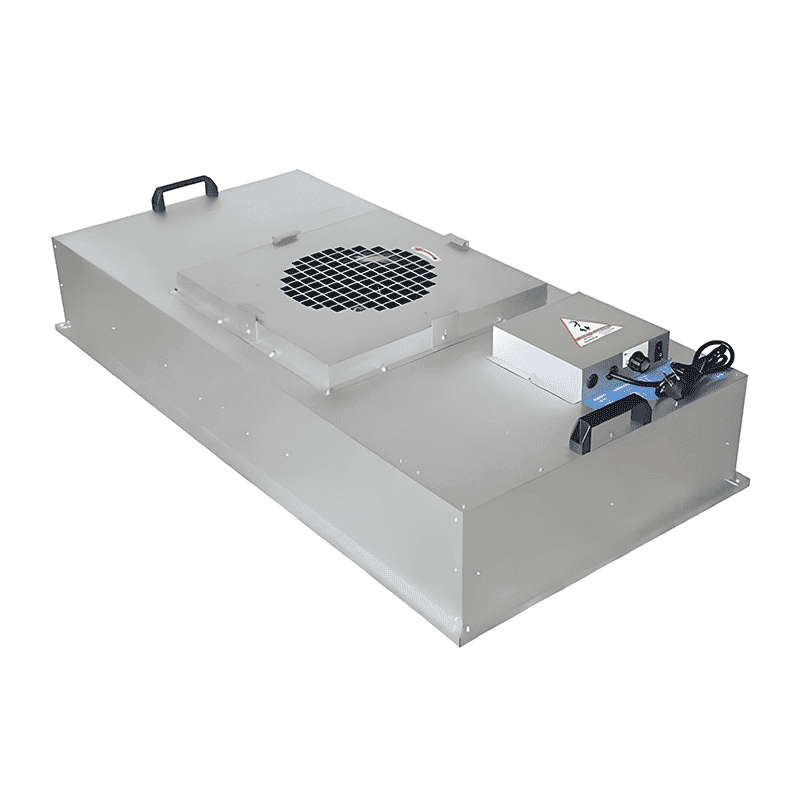
The FFU (Fan Filter Unit), as a modular terminal air supply device, has become the ideal choice for clean environments in industries such as electronics, semiconductors, biopharmaceuticals, and medical devices due to its unique advantages.
I. Core Functions: Cleanliness, Flexibility, and Efficiency
1. Creates Localized High-Cleanliness Environments
Working Principle: The built-in fan in the FFU draws air from the top, which passes through a High-Efficiency Particulate Air (HEPA) filter or an Ultra-Low Penetration Air (ULPA) filter. It then supplies this air as a uniform vertical or horizontal airflow, creating a stable, clean air layer.
Customer Value: A single FFU is an independent air supply unit. Multiple FFUs combined can easily create localized environments with high cleanliness levels, such as Class 10, Class 100, or Class 1000, within the workshop. Examples include clean tents covering assembly lines or equipment isolation areas.
2. Flexible Layout, Easy Upgrades and Retrofits
Working Principle: FFUs feature a modular design, allowing them to be flexibly installed on existing ceiling grids like "building blocks," without the need for extensive centralized air ducting systems.
Customer Value:
Easy Installation & Maintenance: Individual FFUs can be installed or removed independently without affecting the operation of other units, simplifying maintenance.
Facilitates Renovation & Expansion: When workshop layouts change or cleanliness upgrades are required, simply adjusting the layout and quantity of FFUs is sufficient, offering low cost and short implementation time.
3. Energy Saving and Low Operational Costs
Working Principle: Compared to traditional centralized air supply systems, FFU systems have lower duct resistance, and the fans are closer to the supply points, resulting in higher efficiency. Furthermore, the operation of FFUs can be controlled by zone and time based on process requirements.
Customer Value: During non-production hours or in unoccupied areas, the airflow speed can be reduced or some FFUs can be turned off, significantly reducing energy consumption and aligning with green manufacturing philosophy.
4. Negative Pressure Sealing Ensures Filtration Efficacy
Working Principle: The fan is located upstream of the filter, placing the filter under negative pressure. This design ensures that even if the cabinet has minor leaks, air leaks in from the outside, preventing contamination of the filtered clean air.
Customer Value: Guarantees the cleanliness of the supplied air, providing an additional layer of quality assurance.
The FFU is not just a cornerstone for building cleanrooms; it is also a capable partner in achieving smart manufacturing and lean production. We are ready to provide professional selection advice and layout design solutions. Please feel free to inquire at any time.
| Parameter | FFU Clean Unit | |||||
| Device Size | 575mm*575mm*300mm | 1175mm*575mm*300mm | 1175mm*1175mm*300mm | |||
| Filter size | 570mm*570mm*69mm | 1170mm*570mm*69mm | 1170mm*1170mm*69mm | |||
| Air volume | 500m³/h | 1000m³/h | 2000m³/h | |||
| Air velocity | 0.3m/s-0.5m/s | |||||
| Filtration efficiency | ≥0.5μm dust ≥99.95 per cent | |||||
| Full pressure | 170pa-210pa | |||||
| Noise level | 52-56dba | |||||
| Equipment material | Painted steel plate/aluminium zinc plated plate/304 stainless steel | |||||
| Box insulation | (Optional) Rubber Plastic Insulation Grade B1 | |||||
| If you have special needs for the product, please let us know the needs. | ||||||